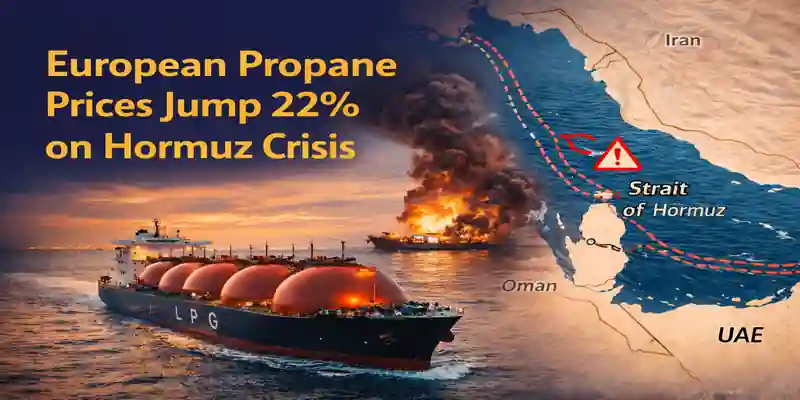
European propane prices surged by more than $100 per tonne on Monday as tensions in the Middle East raised fears of supply disruption. The sharp rally in European propane prices reflects growing concern over shipping risks near the Strait of Hormuz.
The move significantly outpaced gains in crude oil, underlining strong bullish momentum in the LPG market.
Northwest Europe Propane Hits Multi-Month High
The northwest Europe propane swap for April delivery climbed to an intraday high of $590/t by 09:30 GMT. This marks a $106/t increase from Friday’s close, equivalent to a 22% jump in a single session.
The spike represents the sharpest one-day gain ever recorded in European propane markets. Even during the Covid-19 pandemic, prices did not rise by more than $50/t in one trading session.
Asia-Pacific Propane Prices Also Climb
In the Asia-Pacific region, paper contracts also rallied strongly.
-
Far East Index (AFEI) propane paper rose 17% to $657/t, up $95.50/t on the day.
-
Saudi Aramco-linked contract price (CP) paper increased nearly $50/t to $595/t, reflecting an 8% gain.
Physical trading activity in Asia-Pacific remains subdued. Sellers are reportedly holding back cargoes amid uncertainty.
Strait of Hormuz Disruption Intensifies Supply Concerns
The conflict has effectively disrupted shipping through the Strait of Hormuz, a key transit route for Middle Eastern LPG exports.
Asia-Pacific, the world’s largest propane consuming region, depends heavily on Middle Eastern supply, particularly from Iran. Shipping data indicates that Iran exported around 9 million tonnes of propane to Asia-Pacific in 2025, making it one of the region’s top suppliers.
Any sustained blockage in the strait could tighten global LPG balances significantly.
China’s Supply Shift Adds to Market Volatility
China, the world’s largest propane consumer, has been adjusting its sourcing strategy.
In 2025, China reduced LPG imports from the United States to 11.5 million tonnes, down from 17.8 million tonnes in 2024. The shortfall was compensated by higher inflows from the Middle East and other suppliers.
This growing dependence on Middle Eastern propane increases China’s exposure to supply risks stemming from the current conflict.
Additionally, operational disruptions at Ras Tanura have added to supply-side uncertainty.
Europe Faces Risk of US LPG Diversion
Europe relies heavily on US LPG imports. However, tighter global supply could redirect more US cargoes toward Asia-Pacific.
Northwest Europe’s imports of US LPG have already declined by 11% year-on-year to 578,000 tonnes in February. This tightening supply has pushed the physical premium to a three-year high against paper contracts.
If Asia-Pacific buyers increase demand for US cargoes, European availability may shrink further.
Crude Oil Gains Lag Behind Propane Rally
While front-month Brent crude futures initially rose by around 13%, they later pulled back. Propane’s stronger performance highlights the specific supply vulnerability within the LPG segment compared to broader energy markets.
Outlook: Volatility May Continue
The current rally is driven largely by risk premium pricing. If the expected supply shock fails to materialise, prices could correct sharply.
Several factors may soften demand:
-
China’s propane dehydrogenation (PDH) plants are expected to cut operating rates by at least 10% in the coming week.
-
Reduced PDH demand could lower import requirements.
-
A sustained diplomatic resolution could ease freight and insurance pressures.
For now, the market remains highly volatile, with supply risks dominating sentiment across both European and Asia-Pacific propane markets.